
 English
 中文简体
The Importance and Challenges of Marine Anchors Marine anchors are essential components in the operation of vessels, playing a critical role in ensuring the stability and safety of ships while they ar...
READ MORE



Nov 12, 2026
There is a particular kind of anchoring that happens in two metres of water or less: on a tidal flat, along a weedy lake edge, over a river sandbar, or above a patch of reef. The boat has to stop, and stay stopped, while the crew fishes, swims or waits out the tide. A heavy anchor with a long scope of chain is the wrong tool here, because there is no room to lay out rope and the angle of pull is steep. That is the gap shallow water anchors fill. We have been making anchors for fishing boats, workboats and aquaculture rafts for well over a decade, and the questions we receive on this subject are remarkably consistent. So let us walk through how these anchors actually generate holding force, and how to pick one that suits the bottom you anchor over.
Content
Every anchor has two jobs: create a fixed point on the seabed, and release it again without a struggle. In deep water, a long catenary of chain absorbs shock and keeps the pull on the anchor nearly horizontal. In shallow water, that luxury disappears. The rode may be only three or four times the water depth, so the anchor is loaded at a steep angle, and the boat's motion reaches it almost directly.
That means the bottom itself has to do most of the work. Holding power in shallow water comes from a small area of soil being loaded hard, rather than from the sheer mass of the gear. Understanding this single idea explains almost everything else about how these anchors behave.
These are the powered poles now common on bass boats and flats skiffs. A rigid pole, usually aluminium, is driven vertically into the bottom, and often a pair is used so the boat cannot pivot around a single point. The holding force comes from two things: skin friction where soil grips the shaft, and the bearing resistance of the soil beneath the foot. A pole set into packed sand behaves much like a nail driven into timber.
The limits are physical. Pole length caps the depth at around two and a half to three metres, and the spike simply cannot penetrate rock, hardpan or a thick shell bed. They shine over sand, silt and grass roots, and they deploy in seconds, which is why they are so popular with anglers working a shoreline.
The second family is older and more versatile: lightweight fluke anchors, mushroom anchors, grapnel hooks and compact stockless designs. These are lowered to the bottom and then drawn along it until a fluke or a crown bites. Here the geometry does the work. The shank and fluke are arranged so that a horizontal pull tips the fluke downward into the soil, and the harder the boat pulls, the deeper it goes.
Fluke anchors are the classic solution for mixed sand and mud in this depth band, and a well-set Danforth pattern is still one of the most reliable shapes we produce for small craft and tenders.
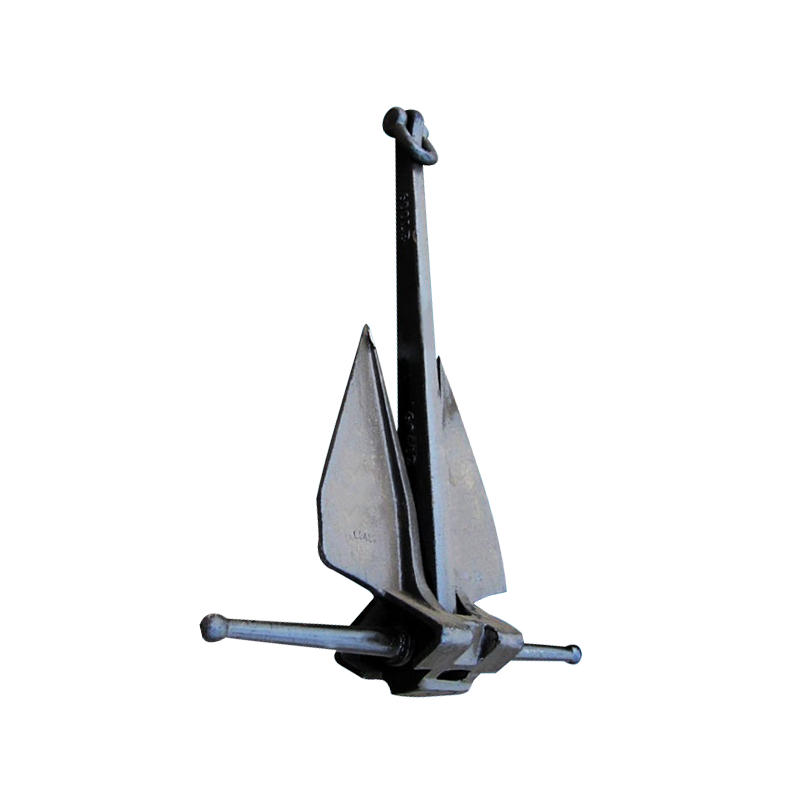 YF-Danforth Fluke Anchor for Sand and MudFluke anchor with A and B claw-head variants and nominal weights from 60 kg to 25,000 kg, suited to mixed sand and mud moorings.View Product →
No single anchor is right everywhere, and the honest answer to "which one works here" always starts with the seabed. The table below is the rough guide our sales team uses when a customer describes a new mooring site.
| Bottom type | What the anchor meets | Style that suits it | Setting tip |
|---|---|---|---|
| Firm sand | High shear strength, good drainage | Fluke anchors and spikes | Apply a slow, steadily increasing pull |
| Soft mud and silt | Low shear strength, high water content | Wide-fluke anchors or mushroom anchors | Give extra scope and set gently |
| Stiff clay | Cohesive, resists penetration | Narrow, sharp flukes with a heavier shank | Break the surface, then let it settle before setting |
| Weed and grass | A mat of roots over softer ground | Mushroom anchors or a spike through the mat | Clear a patch, or pull the mat free first |
| Rock and hardpan | Effectively no penetration | Hook patterns, or moor to a fixed point | Choose another spot rather than force a set |
| Gravel and shell | Variable and often unstable | Fluke anchors with sharp tips | Set short and check for drag |
In soft, weedy ground, a mushroom shape is hard to beat. Its rounded crown sinks into the silt and the surrounding soil closes over it, giving a surprising amount of resistance for its modest weight.
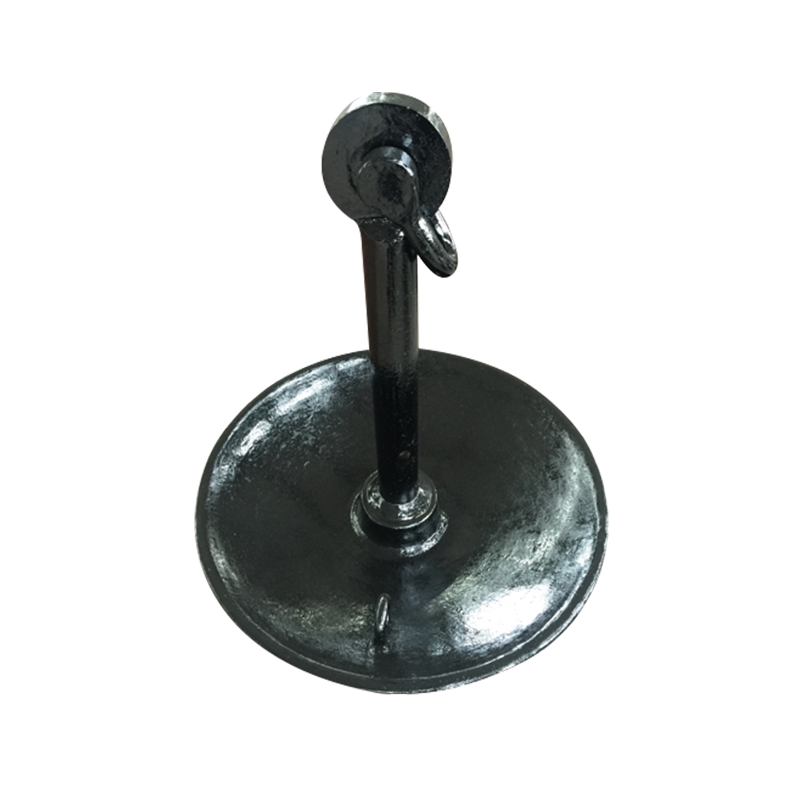 YF-Mushroom Anchor for Soft and Weedy GroundMushroom-style anchor with smooth or toothed edges; the rounded crown is intended to settle into silt and softer substrates for cable securing.View Product →
If you want a fuller treatment of the technique, our step-by-step guide to anchoring a boat covers scope, transits and overnight practice in more detail.
For tenders, kayaks and small inflatables, a lightweight pattern that stows flat and sets by hand is usually the most practical choice, and it is the reason we still keep traditional light-weight designs in production alongside the high holding power ranges.
 YF-GB 11579-89 Lightweight Anchor for Small CraftLightweight Danforth-style anchor with a crossbar and 30° or 50° setting; nominal weights from 14 kg to 20,000 kg for varied soils.View Product →
A shallow water anchor lives in abrasive ground, so it earns its keep only if it is inspected. Rinse after every saltwater trip, look closely at welds and galvanising on fluke edges, and check that shackle pins are secure and wired. Replace rope that shows chafe or stiffness; a rode failure in a tideway is far more expensive than a new length of line.
The limits deserve equal honesty. A spike anchor will not hold on rock. A single pole allows the boat to swing, so a wind shift can change everything. And in very soft mud, no small anchor holds indefinitely; you add scope, add a second anchor, or move. Knowing when to move is part of good seamanship.
Two is better than one whenever the boat must stay pointed in a fixed direction, as when fishing a shoreline in a crosswind. A pair set fore and aft, or a pair of poles at the transom, removes the swing that unsettles both fish and crew.
Often yes, in settled weather and good ground, but it should not be your only plan. Check the forecast, note the tide range, and pick a spot where a slow drag would not put you on a lee shore.
Shallow water anchoring is less about brute weight and more about reading the bottom and matching a shape to it. Once that clicks, the whole system, from the pole at the transom to the chain leader and the splice in your rode, starts making sense as one piece of equipment. If you are working out what suits a particular boat, bottom or mooring site, our team is always glad to talk it through and to produce anchors to the standard and certification your project requires.
The Importance and Challenges of Marine Anchors Marine anchors are essential components in the operation of vessels, playing a critical role in ensuring the stability and safety of ships while they ar...
READ MOREStability Challenges of Aquaculture Equipment: Why Are Aquaculture Mooring Anchors So Important? In modern aquaculture, especially offshore or offshore aquaculture, equipment stability is the cornerst...
READ MOREThe Role of a PE Yacht Anchor in Enhancing Mooring Stability The stability of a yacht in rough waters is influenced by various factors such as wind, waves, and currents. One of the most critical eleme...
READ MOREWhat materials are used for steel spherical buoys, and what are their structural advantages? As a key component of marine and inland navigation systems, the structural design and material selection of...
READ MORE
Copyright © Nantong Yangfan Marine Equipment Co., Ltd. All Rights Reserved.
