
 English
 中文简体
The Importance and Challenges of Marine Anchors Marine anchors are essential components in the operation of vessels, playing a critical role in ensuring the stability and safety of ships while they ar...
READ MORE



Oct 20, 2026
Few pieces of marine hardware work as hard as an anchor chain. It connects a vessel to the seafloor, endures constant tension and twisting, and takes the shock when a ship swings on its anchor. When someone asks us how anchor chains are made, we usually say that there is much more to it than welding a few steel rings together.
At Nantong Yangfan Marine Equipment, we have manufactured anchor chains and mooring accessories for over a decade. As a marine anchor manufacturer with our own 20,000-square-meter factory, we have built chains for cargo ships, yachts, aquaculture farms, and offshore projects. This experience has taught us that the difference between a good chain and a great one lies in the details.
Content
The manufacturing process begins with high-strength steel bars. Ship anchor chain typically uses round steel in grades such as CM490 or CM690, while stainless steel chain is chosen for yachts and certain offshore environments. The material must balance tensile strength with toughness, because a chain that is simply hard may crack under shock loads.
We check every incoming batch against the mill certificate, verifying the chemical composition and mechanical properties. Then the bar is cut into precise link lengths. Each link diameter, pitch, and internal width must follow the required standard, whether it is ISO, British Standard, German DIN, or a specific class-society specification.
The cut steel blanks are heated in an induction furnace until they reach a forging temperature of roughly 950 to 1,100 degrees Celsius. At this point, the steel glows a bright orange-red and becomes plastic enough to form without cracking. The hot bar is placed into a bending machine, which wraps it around a mandrel to create the open shape of a chain link.
For stud link chain, a steel stud is inserted across the middle of the link while the metal is still hot. This stud maintains the link's shape and prevents the chain from kinking when it wraps around the windlass or the gypsy wheel.
Once the link is shaped, the two open ends are joined. Modern anchor chain production relies on flash butt welding, where the ends are clamped in a welding machine, aligned, and then pressed together under a high electric current. The mating surfaces melt and fuse, and the joint is forged as it cools. This creates a continuous weld with deep penetration and high mechanical strength.
After welding, excess flash is trimmed away and the link is calibrated in a sizing press. Operators inspect every weld visually and, where required, carry out magnetic particle inspection to ensure there are no surface cracks or voids.
Flash butt welding is preferred over traditional forging for many anchor chain sizes because it creates very consistent weld zones. The final joint has a grain structure that is very similar to the base material, so the chain does not develop a weak point at the connection.
For those exploring the broader range of connection hardware, our guide to types of shackles for marine rigging may be a useful resource.
Anchor chain would not be fit for purpose without heat treatment. After welding, the chain is heated again, quenched, and tempered to refine the steel's grain structure. This process, called quenching and tempering, gives the chain its combination of hardness and ductility. A properly heat-treated chain will stretch slightly under extreme load instead of snapping without warning. Normalizing is sometimes performed after welding to soften the steel and relieve internal stresses before any further processing. For high-strength chains, we combine normalizing with a quench-and-temper cycle. The exact time and temperature are adjusted according to the steel grade and the required tensile level, so each batch receives a dedicated heat-treatment plan.
The table below summarizes the main manufacturing stages and what they achieve.
| Stage | What Happens | Why It Matters |
|---|---|---|
| Cut | Steel bar is cut into link blanks | Sets the link size and weight |
| Heat | Blanks are heated to forging temperature | Makes the steel formable |
| Bend | Blanks are bent around a mandrel | Creates the link shape |
| Weld | Open ends are flash butt welded | Forms a solid continuous joint |
| Heat treat | Chain is quenched and tempered | Develops final tensile strength and toughness |
| Test | Samples are proof loaded and broken | Confirms the chain meets class requirements |
If you have questions about production tolerances or inspection documents, you can always reach our team through the FAQ section of this site.
Individual links are finally assembled into a continuous chain. In a stud link chain, each link is engaged with two adjacent links and a stud is fitted as the next link is closed. Assembly is currently automated in our workshop, with precise indexing to keep the pitch and length consistent.
Our standard marine anchor chain is offered in a variety of diameters and grades to match windlass capacity and vessel size.
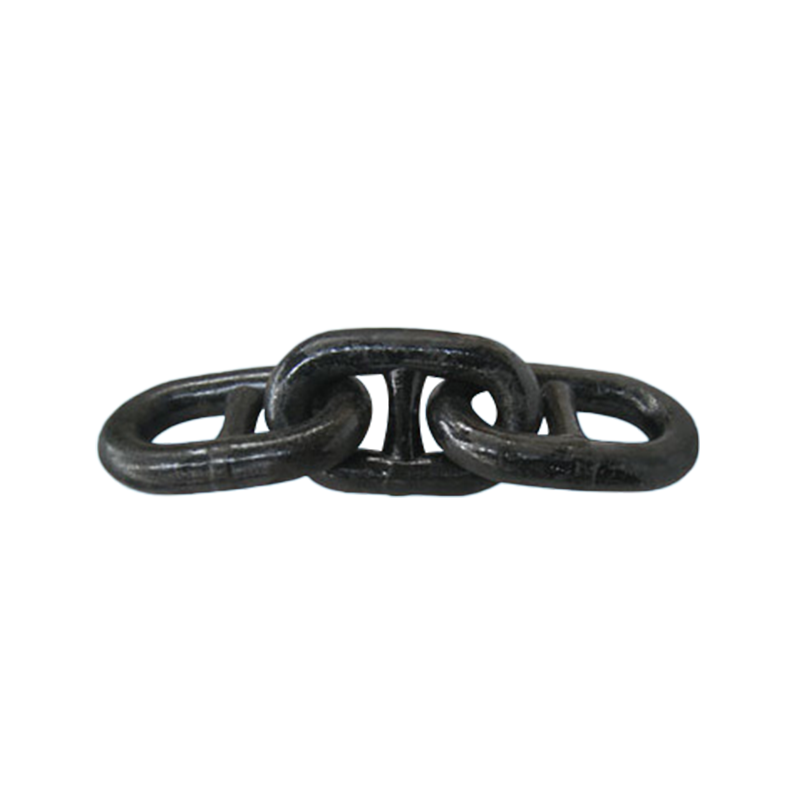 Heavy-Duty Studded Anchor Chain in Multiple GradesThis anchor chain forms the critical link between vessel and anchor, offered in diameters from 12.5 mm to 162 mm and grades AM1-AM3. Its high tensile strength and corrosion resistance suit demanding marine conditions, matching windlass capacity and vessel size.View Product →
An anchor chain system is never a single continuous string. It usually includes enlarged links, end links, kenter shackles, swivels, and end shackles to transfer the load safely between the anchor and the chain locker. The swivel, for example, prevents the chain from twisting when the vessel yaws around the anchor. A quality swivel is machined from alloy steel and heat-treated for reliable swiveling under load.
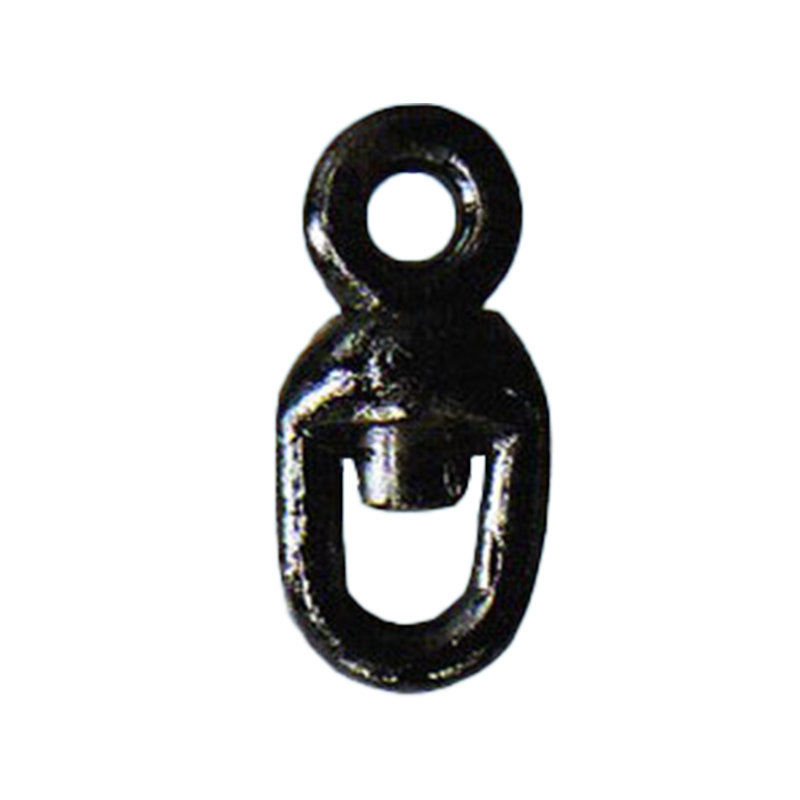 Precision Swivel to Prevent Chain TwistingThis swivel ensures free rotation, preventing the anchor chain from twisting or winding under uneven forces. Its heat-treated alloy steel construction and smooth operation reduce wear, extend service life, and maintain reliable performance when the vessel yaws around the anchor.View Product →
Kenter shackles are used when a section of chain needs to be detached, such as for anchoring or cable separation. They are designed with a flat section and countersunk pins so that they pass through the cable lifter smoothly.
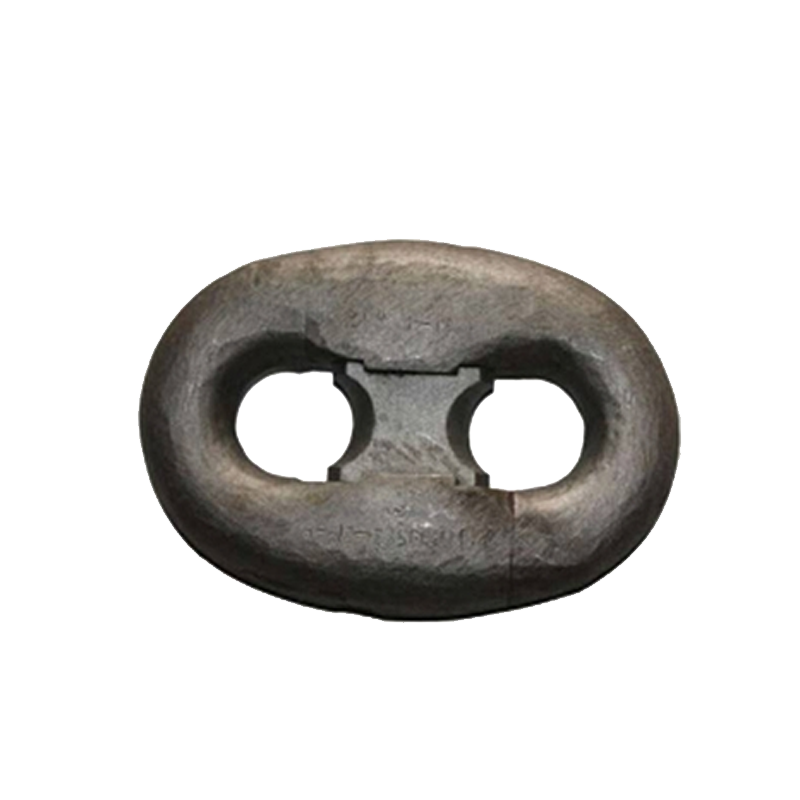 Secure Kenter Shackle for Chain DetachmentDesigned for easy disconnection of chain sections, this Kenter shackle features precision machining and a secure fastening mechanism. It maintains stability under high loads and vibrations, reducing accident risk in marine engineering and ensuring smooth passage through the cable lifter.View Product →
After assembly, the chain receives its final surface treatment. Hot-dip galvanizing is the most common option for carbon steel anchor chains because the zinc coating protects the link from saltwater corrosion. The chain is cleaned, pickled, fluxed, and then immersed in a bath of molten zinc at around 450 degrees Celsius. The result is a uniform, sacrificial zinc layer that gives many years of service in marine conditions.
For stainless steel chain, we typically use electropolishing or passivation to improve corrosion resistance and give an even appearance. If a customer specifies a painted or bituminous finish, we apply that as well.
Before shipment, every anchor chain goes through a final dimensional check. Link length, width, and diameter are measured; the chain is laid out to confirm its actual length; and all surface marks are inspected. We compile a dossier with heat numbers, test results, and any required certificates from classification societies such as CCS, ABS, BV, DNV, LR, or NK. This paperwork gives you a complete traceability chain from the original steel batch to the finished product.
So how are anchor chains made? It is a precise sequence of heating, bending, welding, heat treatment, assembly, and testing. It takes experienced workers and a disciplined quality system to make sure that every link performs when it is lowered into the sea. That is the standard we try to meet every day at Nantong Yangfan Marine Equipment. From the first cut of the steel bar to the final zinc bath, our goal is simple: to deliver a chain that can be trusted when it disappears beneath the dark water.
The Importance and Challenges of Marine Anchors Marine anchors are essential components in the operation of vessels, playing a critical role in ensuring the stability and safety of ships while they ar...
READ MOREStability Challenges of Aquaculture Equipment: Why Are Aquaculture Mooring Anchors So Important? In modern aquaculture, especially offshore or offshore aquaculture, equipment stability is the cornerst...
READ MOREThe Role of a PE Yacht Anchor in Enhancing Mooring Stability The stability of a yacht in rough waters is influenced by various factors such as wind, waves, and currents. One of the most critical eleme...
READ MOREWhat materials are used for steel spherical buoys, and what are their structural advantages? As a key component of marine and inland navigation systems, the structural design and material selection of...
READ MORE
Copyright © Nantong Yangfan Marine Equipment Co., Ltd. All Rights Reserved.
