
 English
 中文简体
The Importance and Challenges of Marine Anchors Marine anchors are essential components in the operation of vessels, playing a critical role in ensuring the stability and safety of ships while they ar...
READ MORE



Nov 16, 2026
Few questions come up as often on a working dock as this one: how does a Danforth anchor work? The short answer is that it does not hold by weight alone. It holds by burying two flat, hinged flukes in the seabed and letting the boat's own pull drive them deeper. That simple idea has kept the design in service for the better part of a century, and once you understand the mechanics, setting one stops being a guessing game.
Below we walk through the parts, the sequence of events on the seabed, the ground where the design shines, and the small habits that separate a confident set from a long afternoon of dragging.
Content
A Danforth is what the trade calls a hinged fluke anchor. There is no huge mass of iron in the crown and no curved ploughshare. Instead, the holding power comes from surface area, geometry and a very deliberate bit of self-aligning behaviour. Four features do all the work.
These are the large, flat, roughly triangular plates at the base of the anchor. Their leading edges are bevelled so they can cut into sand, mud or clay rather than skid across it. Each fluke pivots on the same hinge at the crown, which is what allows the anchor to keep a useful angle of attack no matter how the shank is lying.
Most people mistake the crossbar for a handle. It is not. The stock sits at the crown end, at right angles to the flukes, and its job is to topple the anchor on landing so that it always lies flat on the seabed with one fluke pointing down at the ground. Without it, the anchor could settle on its side and never start.
The shank is the long bar running from the crown to the shackle eye. It transmits the pull of the rode down to the flukes, and it also keeps that pull close to horizontal, which is exactly what the flukes need. The hinge pin is the hardest-working piece of metal on the whole assembly, and it is the first thing to inspect when an anchor starts to feel sloppy.
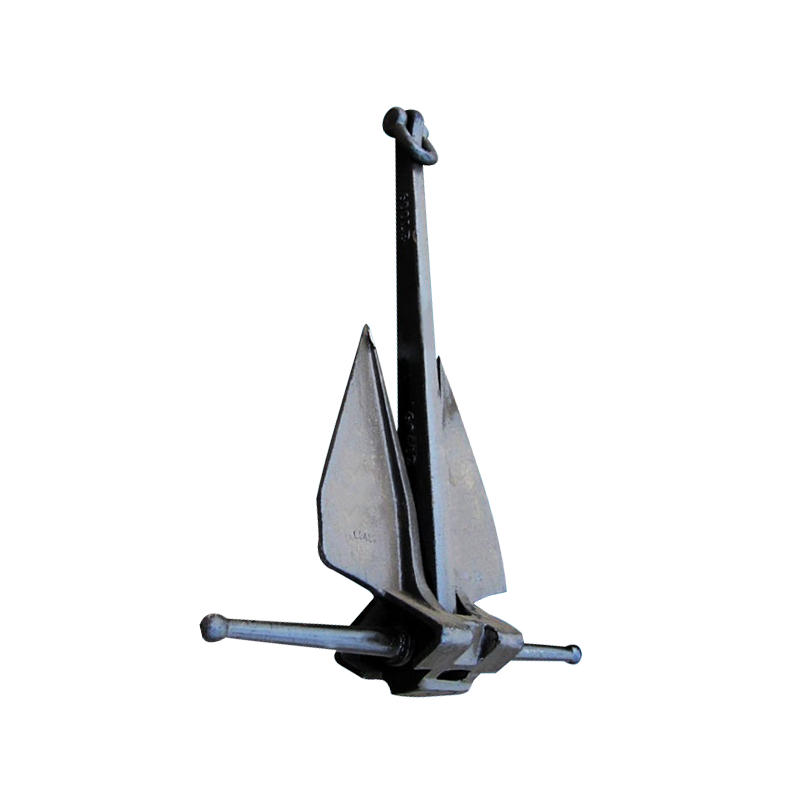 YF-Danforth Anchor with Crossbar and A/B Claw-Head OptionsHigh-holding Danforth anchor range with crossbar balance, A/B claw-head variants, and nominal weights from 60 kg to 25,000 kg for working boat systems.View Product →
Well-made versions of this pattern use forged or cast high-strength steel, hot-dip galvanising for corrosion resistance, and a hinge that stays tight season after season. A loose hinge is not a cosmetic issue; it changes the angle at which the flukes enter the ground.
The set is a sequence, not a single moment. Skipping a step is the usual reason an anchor that looks fine on deck refuses to bite.
If you feel a light, springy vibration instead, the flukes are skipping over the bottom. Haul up, clear whatever weed or shell they picked up, and start again somewhere slightly different.
Here is the part that explains most anchoring disappointments. A Danforth holds best when the rode pulls at a shallow angle, close to parallel with the seabed. That is why the recommended scope is generous: roughly five times the water depth in calm conditions, and seven to eight times when wind or current is expected. Chain helps enormously because its weight sags into a curve that keeps the pull low even when the boat is pitching.
Shorten the scope and the rode starts lifting the shank. The flukes rotate out of their digging angle, the surface area in contact with the soil drops, and the anchor begins to trip. It is not that the anchor is too small; it is that it has been asked to hold at the wrong angle. The same thing happens when a wind shift swings the boat across the anchor, so give a Danforth room to re-seat rather than fighting the swing with a tight rode.
The design has clear strengths and equally clear limits. Knowing which is which before you drop saves a lot of guesswork.
| Seabed | Performance | What to expect |
|---|---|---|
| Sand | Excellent | Flukes bury quickly and hold firmly; easy to break out on retrieval. |
| Mud and soft silt | Very good | Deep burial but lower ultimate strength; allow extra scope and swing room. |
| Firm clay | Good | Needs a firm, steady pull to start the bite; holding is high once buried. |
| Heavy weed or kelp | Poor | Flukes foul before they reach the bottom; consider a different pattern. |
| Rock and coral | Poor | Tips cannot penetrate; risk of jamming. Use a trip line if you must try. |
| Hard packed gravel | Fair | May skitter before it catches; set gently and confirm with transits. |
An anchor is only as good as the system attached to it. A short length of chain between the shank and the rope does three jobs at once: it adds weight near the anchor to keep the pull low, it absorbs shock loads that would otherwise jerk the flukes loose, and it protects the rope from abrasion on the bottom.
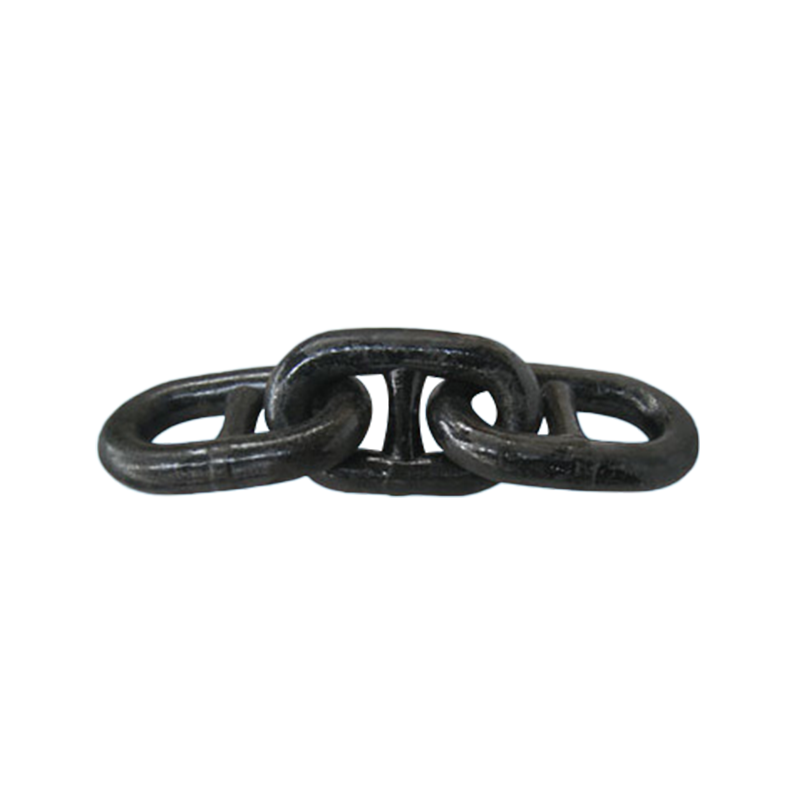 Studded Anchor Chain for Ship and Marine EngineeringStud-link anchor chain in 1/2 inch to 6-3/8 inch diameters, with AM1/U1–AM3/U3 grades and proof and breaking load data for marine anchoring systems.View Product →
Check the shackle every season. The pin should be seized with stainless wire or a cable tie so it cannot work loose under cyclic loading, and the shackle should be rated at least as strong as the chain. A hardware-store shackle is the cheapest part of the system and the most common point of failure.
Give the anchor a quick look at the end of each season. Worn galvanising, a rounded or chipped fluke tip, or a hinge pin with visible play all reduce holding power before they become obvious on the water. Touch up bare spots with cold galvanising spray, replace a worn pin rather than tolerating it, and store the anchor where the flukes are not bearing the boat's weight against a roller. Treated well, a good Danforth will outlast several boats.
Rarely well. The flukes are designed to penetrate soft to firm soils, not to hook around rock. In kelp the anchor tends to arrive at the bottom wearing a bundle of weed, which prevents any bite at all.
The change in direction lifts the shank and rolls the flukes out of their digging angle. Pay out more scope so the pull stays low, or reset the anchor on the new bearing once the swing settles.
It can, particularly in sand or mud, but moorings need a much heavier scope of chain, a swivel, and a regular diving inspection. A dedicated mooring sinker or a heavier high-holding-power pattern is usually the better long-term choice.
Start at five to one in settled weather and go to seven or eight to one when the forecast turns. In shallow water, add the height of the bow roller above the waterline to the depth before you do the maths.
A Danforth is a wonderfully honest piece of equipment. It does not need electronics or a particular technique; it needs a flat lie on the bottom, a shallow angle of pull and a few seconds of patience while the flukes find their bite. Get those three things right and the anchor will quietly do the rest.
If you would like to go deeper into rode length, scope and setting technique, our complete guide to anchoring a boat walks through it in detail, and the frequently asked questions page covers sizing and certification queries we hear most often from builders and fleet operators.
The Importance and Challenges of Marine Anchors Marine anchors are essential components in the operation of vessels, playing a critical role in ensuring the stability and safety of ships while they ar...
READ MOREStability Challenges of Aquaculture Equipment: Why Are Aquaculture Mooring Anchors So Important? In modern aquaculture, especially offshore or offshore aquaculture, equipment stability is the cornerst...
READ MOREThe Role of a PE Yacht Anchor in Enhancing Mooring Stability The stability of a yacht in rough waters is influenced by various factors such as wind, waves, and currents. One of the most critical eleme...
READ MOREWhat materials are used for steel spherical buoys, and what are their structural advantages? As a key component of marine and inland navigation systems, the structural design and material selection of...
READ MORE
Copyright © Nantong Yangfan Marine Equipment Co., Ltd. All Rights Reserved.
