
 English
 中文简体
The Importance and Challenges of Marine Anchors Marine anchors are essential components in the operation of vessels, playing a critical role in ensuring the stability and safety of ships while they ar...
READ MORE



Nov 05, 2026
Whenever you see a buoy rolling gently on the water, it is easy to assume that it simply floats and stays put. In reality, every buoy is a small floating structure whose position depends on a carefully matched combination of buoyancy, ballast, chain, rope, and anchor. Understanding how do buoys work means looking at both the visible part above the waves and the components hidden below the surface. In this guide, we’ll break it down step by step, drawing on our own experience in manufacturing anchors, chains, mooring buoys, and related marine equipment.
Content
The starting point for every buoy is buoyancy. According to Archimedes’ principle, an object immersed in water experiences an upward force equal to the weight of the water it displaces. A buoy stays afloat because its hull, whether hollow or foam-filled, displaces a volume of water that weighs more than the total mass of the buoy. That is why even a heavy steel buoy can float: its enclosed air space increases displacement while keeping overall weight in check.
Stability is another part of the story. A buoy’s centre of gravity and centre of buoyancy are arranged so that the hull turns upright again after a wave passes. When the buoy tilts, the centre of buoyancy shifts sideways, creating a righting moment that pushes the hull back toward vertical. The exact behaviour depends on the hull shape and the distribution of weight inside.
| Hull shape | Typical application | Main advantage |
|---|---|---|
| Spherical | Mooring and monitoring buoys | Uniform stability from any direction |
| Cylindrical | Mooring buoys in ports and marinas | Large deck area, easy to handle |
| Conical | Navigational marker buoys | Good waterline definition, visible shape |
Floating alone is not enough. To work as a real mooring point, a buoy must remain over a fixed spot on the seabed despite wind, current, and tide. The system that makes this possible is the same family of components we use for ship anchoring:
The chain is often heavier than people expect. A long chain lying on the seabed creates a curve known as a catenary. As the buoy pulls upward in a wave, the weight of the chain lifts off the bottom before the anchor itself has to resist. This “catenary effect” is one of the main reasons buoys do not drag away in strong wind or tidal changes. If you are designing a mooring, the weight of the chain, the size of the sinker, and the bottom condition all need to work together.
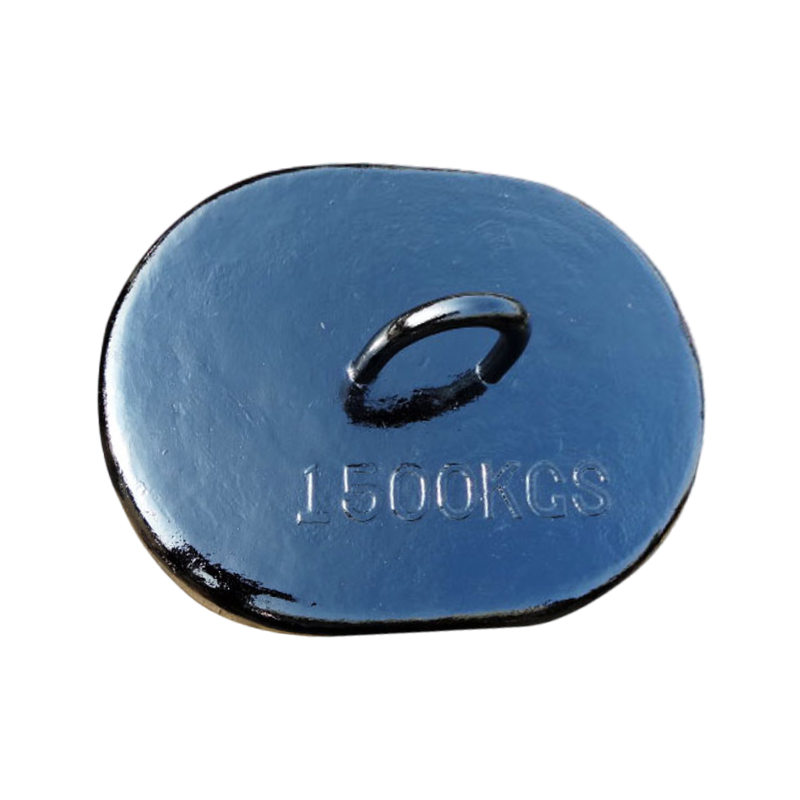 Cast Iron Mooring Sinkers for Stable Seabed FixingThis product page explains how dense cast iron sinkers provide the deadweight needed to hold mooring chains on hard seabeds, complementing the catenary effect described above.View Product →
Cast iron mooring sinkers are a practical choice in many harbours because they are compact, corrosion-resistant, and easy to handle. They provide the deadweight needed to keep the lower end of the chain in place, especially on hard seabeds where ordinary anchors may have trouble digging in.
The chain itself also plays a structural role. It resists abrasion against the seafloor better than rope and adds weight that reduces shock loads. For this reason, we often choose a combination of stud-link or short-link chain near the bottom, with nylon or polyester rode closer to the buoy. The exact setup depends on depth, tide range, and vessel traffic.
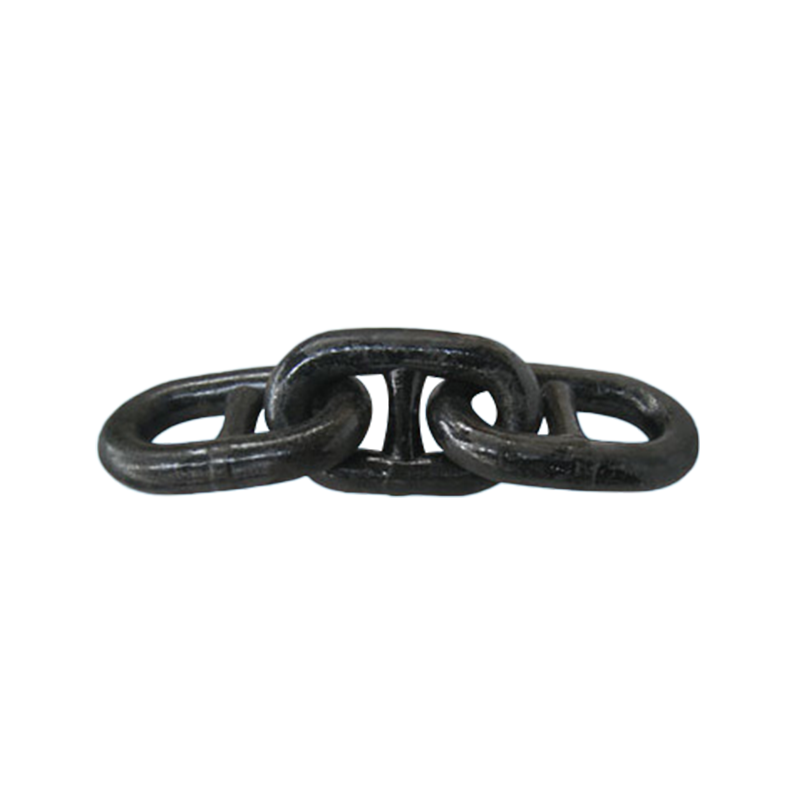 Anchor Chain Specifications for Buoy MooringsThe page offers studded anchor chains in various grades and diameters, with working load limits essential for choosing a chain that stays on the seabed without excessive weight.View Product →
When you specify a chain for a buoy mooring, check the grade and the working load limit. A chain that is too light can be lifted off the seabed by the buoy in every wave, causing the anchor to work loose. A chain that is too heavy adds unnecessary cost and makes deployment more difficult.
Buoys serve different purposes, and their design reflects those jobs. The most common groups are:
Many commercial mooring buoys are made of welded steel, either cylindrical or spherical. The goal is to give the buoy enough reserve buoyancy to support chain weight, mooring rings, and sometimes a light or radar reflector. Choosing the right shape is usually a matter of water depth and expected vessel size.
Steel has been a standard material for mooring buoys because it is strong, repairable, and predictable. A well-built steel buoy starts with a shell welded into a watertight hull, then coated or galvanised to resist corrosion. Internal compartments can prevent total sinking if the shell is damaged, and the steel structure can carry heavy loads without flexing.
Spherical steel buoys are one of the most common designs in both sheltered and exposed moorings. Their round shape distributes wave loads evenly, and they have no large flat surfaces to be hammered by the sea. They are also suitable when the buoy may be approached from any direction because the mooring eye can be located on top or through the centre.
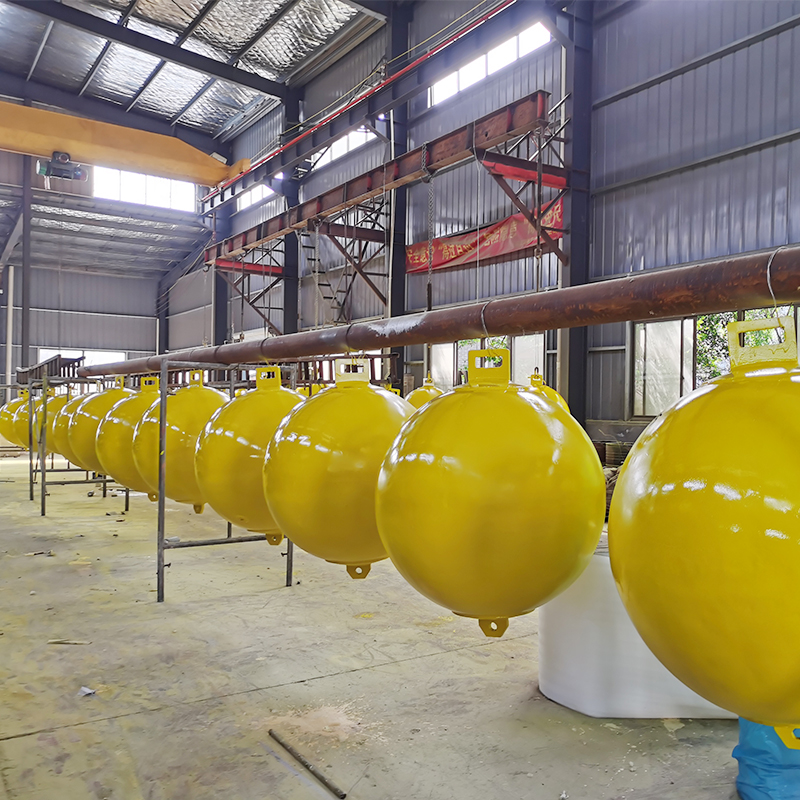 Steel Spherical Buoys for Even Wave Load DistributionThese spherical steel buoys distribute wave forces evenly and tolerate heavy fittings, making them a durable choice for harbour mooring points and aquaculture lines.View Product →
Plastic buoys are lighter and sometimes less expensive, but they often have lower impact resistance and can degrade under ultraviolet light. Foam-filled plastic buoys have an advantage because they cannot flood. Steel buoys, on the other hand, are preferred in commercial and industrial applications where long life, mechanical strength, and the ability to fit heavy deck fittings are more important than weight. In our own production, steel cylindrical buoys are frequently used for harbour mooring points and aquaculture support lines.
Once the buoy body is selected, the mooring system must be designed around local conditions. There are a few critical factors:
| Parameter | Why it matters | Typical approach |
|---|---|---|
| Water depth | Determines chain length and swing radius | Use a scope of at least 3:1 for rope, 5:1 for all-chain |
| Tide range | Changes effective depth and catenary shape | Add slack for low-water condition |
| Bottom type | Affects anchor choice and holding | Sand: anchor; soft mud: sinker; rock: sinker with chain |
| Maximum wind and wave | Sets the peak load on the system | Calculate from vessel size and exposed fetch |
A common mistake is to use too little chain. If the chain is too short or too light, the buoy will jerk vertically every time it rises with a swell. That constant tugging can lift the anchor out of the seabed. A good rule is to size the chain so that at low water, several metres of chain still lie on the bottom. This keeps the anchor at a shallower angle and greatly reduces the chance of dragging.
You also need to think about swing radius. A mooring buoy does not keep a boat in one fixed point; it allows the boat to swing in a circle around the anchor. For a crowded harbour, that radius matters. If the scope is too large, the boat may hit neighbouring moored boats at certain tide stages.
Every buoy is part of a larger anchoring and mooring package. That is why we look at the whole assembly, not just the buoy shell. When a customer asks us about a mooring buoy for a new installation, we discuss the bottom type, the water depth, and the expected vessel size before recommending chain diameter, sinker mass, and anchor type. Sometimes a simple light-weight anchor is not enough; for permanent moorings, a high holding power anchor or a large cast iron sinker gives more secure results.
After installation, regular inspection matters. Check the buoy for cracks, check the chain for wear, and check the swivels for free rotation. Mooring systems work best when they are treated as a complete assembly, with the buoy and underwater parts replaced or serviced at the same time. If you have specific questions about anchors, chains, sinkers, or steel buoys for your project, our FAQ page is a good starting point. We have also written more about the practical difference between temporary and permanent anchoring in our materials on anchoring and mooring.
So, how do buoys work? They work by combining stable buoyancy with a carefully matched subsurface system of chain, shackles, sinkers, and anchors. Each part has a job: the buoy stays on the surface, the chain absorbs wave energy and protects the anchor, and the anchoring weight keeps the whole system on the seabed. Once you understand those roles, you can choose a buoy and mooring package that will stay quietly in place through tides, currents, and storms.
The Importance and Challenges of Marine Anchors Marine anchors are essential components in the operation of vessels, playing a critical role in ensuring the stability and safety of ships while they ar...
READ MOREStability Challenges of Aquaculture Equipment: Why Are Aquaculture Mooring Anchors So Important? In modern aquaculture, especially offshore or offshore aquaculture, equipment stability is the cornerst...
READ MOREThe Role of a PE Yacht Anchor in Enhancing Mooring Stability The stability of a yacht in rough waters is influenced by various factors such as wind, waves, and currents. One of the most critical eleme...
READ MOREWhat materials are used for steel spherical buoys, and what are their structural advantages? As a key component of marine and inland navigation systems, the structural design and material selection of...
READ MORE
Copyright © Nantong Yangfan Marine Equipment Co., Ltd. All Rights Reserved.
