
 English
 中文简体
The Importance and Challenges of Marine Anchors Marine anchors are essential components in the operation of vessels, playing a critical role in ensuring the stability and safety of ships while they ar...
READ MORE



Oct 22, 2026
A buoy looks deceptively simple: a floating body, usually steel or plastic, bobbing on the water's surface. But anyone who works with marine gear knows that a buoy's real work happens underwater. So how do buoys stay in place? The short answer is that they don't hold themselves — a mooring system holds them. Anchors, sinkers, chains, and lines work together to keep the buoy on station through wind, waves, and current. Over the years, our workshop has supplied thousands of anchors, chains, and mooring buoys, and the engineering always comes back to the same principle: balance the buoyancy at the surface with reliable holding force on the seabed.
Content
A buoy's buoyancy decides whether it floats, but buoyancy alone does not resist drift. Without a mooring system, a buoy would simply travel with the current until it grounded or crossed an entire ocean. The mooring line transfers the buoy's upward pull, plus the lateral loads from wind and current, down to an anchor or sinker resting on the seabed.
The seabed attachment has to do two things at once. It must be heavy enough, or shaped well enough, to resist the pull, and it must not creep along the bottom when loads spike during a storm. This is why buoy anchors and sinkers are designed with specific shapes and weights rather than chosen at random.
Although buoy designs vary widely by service type, every system relies on three main elements:
The buoy body itself may be a welded steel cylinder, a sphere, or a foam-filled plastic shell, depending on the application. In our shop, the most commonly built buoy bodies are steel cylinders and spheres, especially for mooring work where strength and long service life matter more than weight savings.
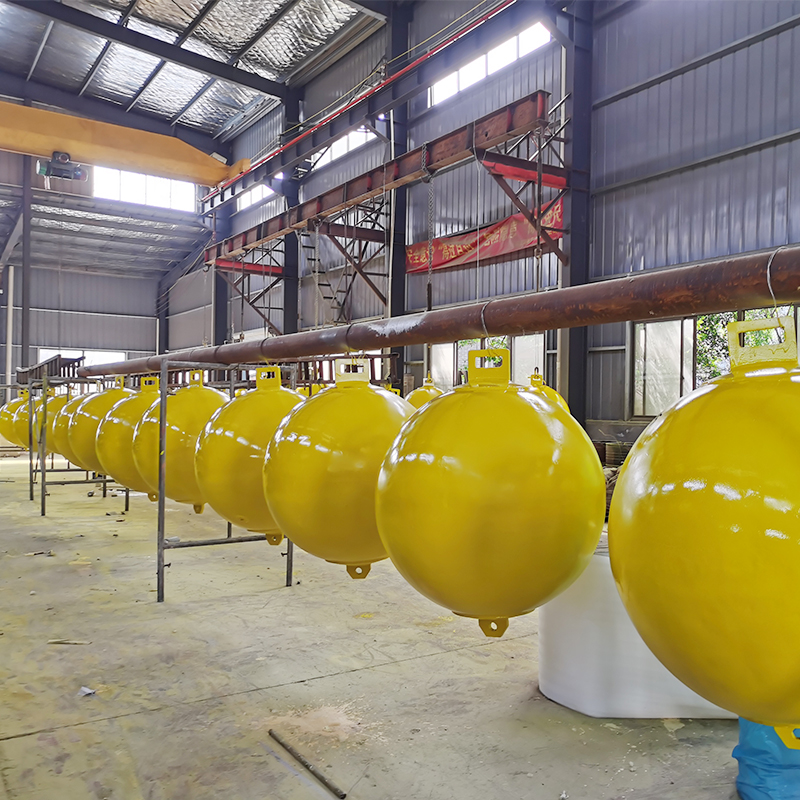 Spherical Steel Buoy for Mooring ApplicationsThis buoy evenly distributes surface forces for high stability and can carry navigation equipment, making it a durable choice for permanent mooring installations.View Product →
The mooring line is not a single material in most installations. A typical setup uses rope in the upper section for easy handling, with chain in the lower section resting on the seabed to resist chafing and add weight. The anchor or sinker finishes the job by locking the whole system to the bottom.
Gravity anchors, usually called sinkers or deadweights, use simple mass. Concrete sinkers are a common choice for permanent moorings in harbors, lagoons, and sheltered anchorages. They hold because their weight plus their broad footprint resist dragging. Cast iron and steel sinkers give more weight in a compact size, which helps when the seabed space is limited or the mooring must be handled from a small vessel.
For softer seabeds, fluke anchors work better. Instead of relying on mass alone, they dig deeper into mud or sand while under tension. Many commercial buoy moorings combine both approaches: a large sinker supplies primary weight, with an anchor buried below or beside it to increase overall holding capacity.
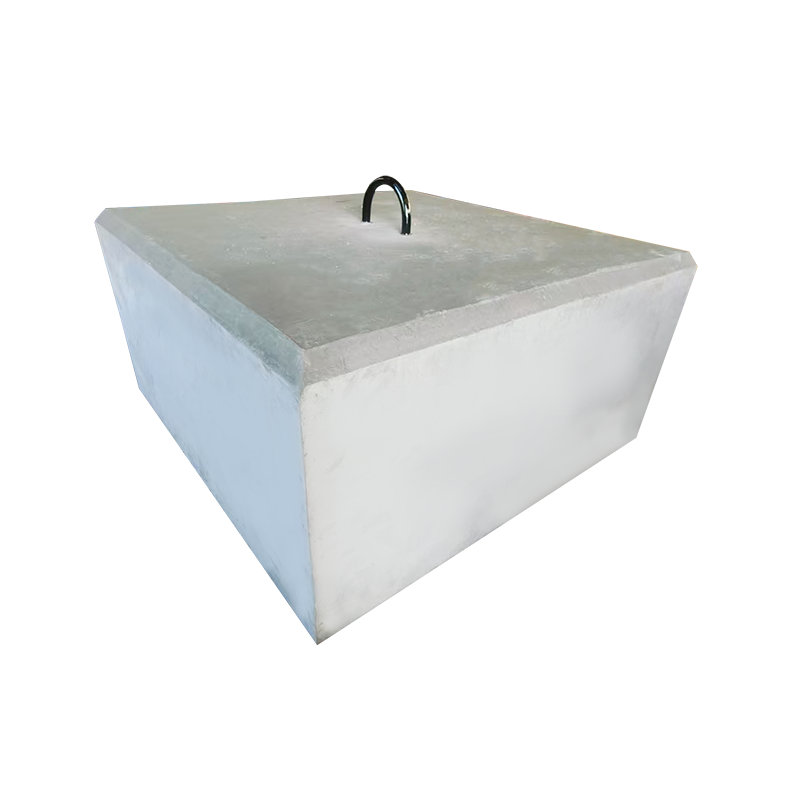 High-Strength Concrete Mooring SinkerWith excellent weight-bearing capacity and corrosion resistance, this sinker secures moorings across varied seabeds, often paired with anchors for enhanced holding power.View Product →
Seabed type decides which approach is right. The same concrete sinker that holds firmly on a hard sand bottom may gradually sink out of sight in soft mud, silently losing part of its effective weight. A proper site survey prevents that mistake before the mooring is installed.
How the mooring line lies in the water is a large part of how a buoy stays put. In shallow and moderate depths, part of the line rests on the seabed, forming a curve called a catenary. When the buoy surges from wave action, a portion of the chain lifts off the bottom, absorbing energy and softening the shock that reaches the anchor. A longer scope, meaning a higher ratio of line length to water depth, provides more catenary effect and lowers the risk of pulling the anchor out of the seabed.
In deep water, taut moorings are sometimes necessary, but a straight line translates small wave-induced movements into large forces at the anchor. That is why most buoy systems keep enough chain on the bottom to maintain a working catenary even at high tide.
| Material | Strengths | Weaknesses | Typical role |
|---|---|---|---|
| Chain | Abrasion-resistant, heavy, long-lasting | Expensive, heavy to handle | Lower section near the sinker |
| Wire rope | High strength, low stretch | Corrodes if not protected, hard to splice | Deepwater mooring lines |
| Synthetic rope | Light, easy to handle, moderate cost | Chafes easily, stretches under load | Upper section and tail lines |
A well-designed buoy mooring nearly always includes chain in the lower section. Chain is heavy, resists abrasion, and is far less likely to be cut or damaged by rocks, propellers, or shifting sediment than rope. Its weight helps maintain the catenary, and it survives repeated contact with the bottom without losing strength quickly.
For a permanent mooring buoy, common practice is a relatively short, thick chain at the anchor connection, a longer chain section running up from the seabed, and a rope tail leading the rest of the way to the buoy. Swivels and shackles tie the sections together while allowing the buoy to rotate without twisting the mooring line.
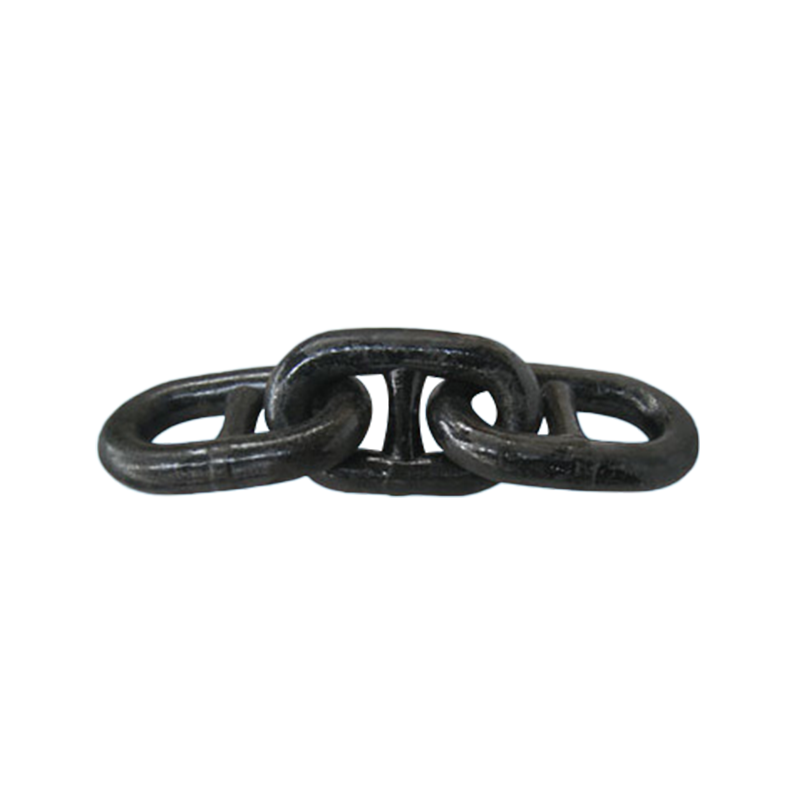 Studded Anchor Chain for Marine MooringRanging from 12.5 to 162 mm in diameter, this chain offers tensile strength and corrosion resistance, critical for matching load in permanent mooring systems.View Product →
Choosing the correct chain diameter is a matter of matching the load. A chain that is too light stretches the catenary, raises the anchor load, and wears out quickly. A chain that is heavier than needed just adds cost and makes servicing the mooring harder.
Designing a buoy mooring is an exercise in imagining every force that will try to move the buoy:
Good mooring design accounts for all these forces at the same time and still leaves a comfortable safety margin. In sheltered harbors, a margin of fifty percent may be enough; on exposed coastlines, experienced designers often double the calculated holding requirement.
The same basic principle applies whether a buoy sits in six feet of harbor water or three thousand feet of open ocean, but the details change dramatically. In shallow water, a heavy sinker and a short length of chain are often all that is needed. In deeper, exposed locations, the mooring becomes a layered system: an embedded anchor, a long chain section, and buoyant synthetic line in the middle of the water column so that the weight of the line does not pull the buoy underwater.
Every location has its own combination of depth, seabed material, current speed, and vessel traffic. That is why off-the-shelf mooring kits rarely perform as well as a system designed for a specific site. If you are planning a new buoy installation, it is worth reviewing the full process of setting up a steel mooring buoy before you order components.
No mooring system lasts forever. Concrete sinkers can become buried or undermined. Chains corrode, especially near the anchor connection where movement and oxygen meet. Rope chafes and loses strength. The buoy itself can leak, or collect marine growth until it sits lower in the water than it should.
Regular inspection catches these problems before a buoy drifts away or pulls its anchor loose during a storm. Checking the buoy body, replacing worn chain, and confirming that the sinker remains properly seated on the seabed should be part of any seasonal maintenance program. The same care that goes into choosing the right components has to go into looking after them. Our FAQ covers some of the most common questions we hear about mooring components and their upkeep.
Buoys stay in place because a well-designed mooring system does the heavy lifting. A buoyant body, a carefully selected line, and an anchor or sinker sized for the location work together to turn the energy of wind, waves, and current into a controlled pull on the seabed — not into a drifting buoy. Whether it is a single concrete sinker in a quiet harbor or a fully engineered offshore buoy system, the principle does not change: floating is easy, staying put is an engineering job.
The Importance and Challenges of Marine Anchors Marine anchors are essential components in the operation of vessels, playing a critical role in ensuring the stability and safety of ships while they ar...
READ MOREStability Challenges of Aquaculture Equipment: Why Are Aquaculture Mooring Anchors So Important? In modern aquaculture, especially offshore or offshore aquaculture, equipment stability is the cornerst...
READ MOREThe Role of a PE Yacht Anchor in Enhancing Mooring Stability The stability of a yacht in rough waters is influenced by various factors such as wind, waves, and currents. One of the most critical eleme...
READ MOREWhat materials are used for steel spherical buoys, and what are their structural advantages? As a key component of marine and inland navigation systems, the structural design and material selection of...
READ MORE
Copyright © Nantong Yangfan Marine Equipment Co., Ltd. All Rights Reserved.
