
 English
 中文简体
The Importance and Challenges of Marine Anchors Marine anchors are essential components in the operation of vessels, playing a critical role in ensuring the stability and safety of ships while they ar...
READ MORE



Oct 29, 2026
It looks simple from the surface: a round steel or plastic buoy bobs quietly in the water while boats tie up beside it. Yet day after day, through wind, current and tide, it stays in roughly the same spot. The reason is not luck. A buoy stays in place because it is held there by a carefully assembled mooring system, and almost all of that system is hidden underwater.
In this guide, we explain how buoys stay in place in practical terms: what holds them on station, how depth and weather change the design, and which components matter most. As a manufacturer of steel mooring buoys, anchors, sinkers, anchor chains and related mooring hardware, we also offer a practical view of why these parts work so well together.
Content
Every buoy, from a small channel marker to a large ocean data buoy, works on the same principle. The visible float is only the top of the system. Below the waterline, three or four main parts do the work:
The secret is not any single component; it is how the parts work together. The anchor delivers holding power. The chain adds weight near the seabed. The rope brings elasticity. Together they absorb the forces of wind, wave and current while keeping the buoy within a small watch circle.
The bottom component is the real foundation of a buoy mooring. In sheltered water, the main load may be only the wind pushing the buoy along. In open water, current and waves can create forces measured in tons, so the anchor or sinker must be heavy enough and suited to the seabed below.
For buoy systems, four common types of bottom components are used:
| Type | How It Holds | Best Seabed | Typical Use |
|---|---|---|---|
| Deadweight sinker | Pure weight resists drag | Rock, hard sand, gravel | Harbor buoys, ship moorings |
| Mushroom anchor | Buries in soft bottom | Mud, clay | Navigational marks |
| Fluke anchor | Plows in when pulled | Sand, soft mud | Tidal and temporary buoys |
| Screw anchor | Threaded into the seabed | Soft sand, clay | Permanent mooring fields |
In our daily production, cast iron, steel and concrete sinkers are the most common choice for buoy moorings. They are simple, predictable and almost maintenance-free. A carefully sized sinker does not rely on burial or orientation; it simply stays wherever it is placed by the force of its own weight.
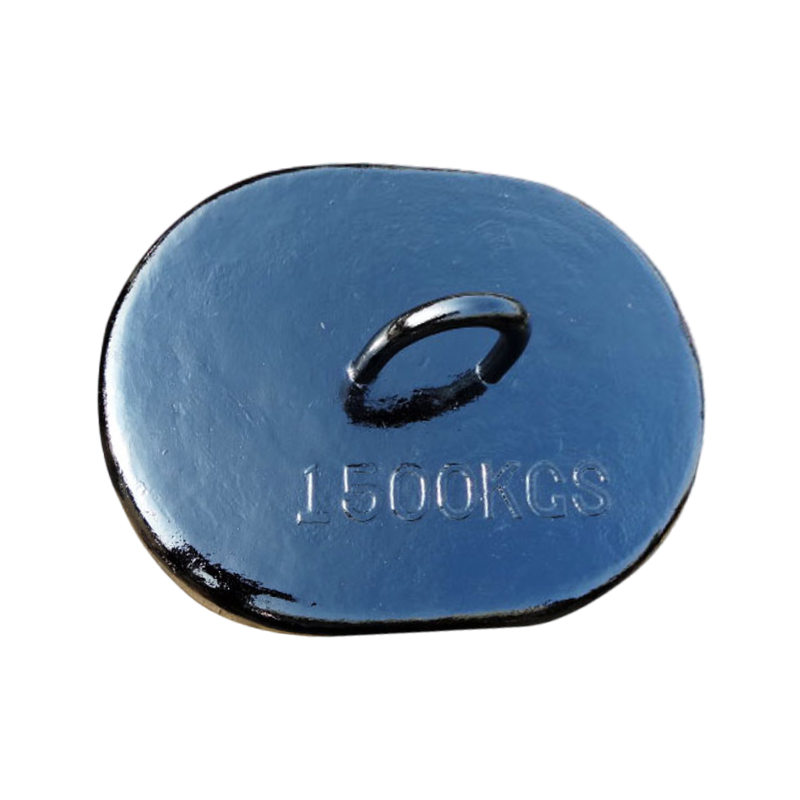 Cast Iron Mooring Sinkers for Heavy-Duty AnchoringThese dense, corrosion-resistant sinkers provide stable holding force on varied seabeds, making them a reliable choice for the deep-water and offshore mooring applications mentioned above.View Product →
The important part is matching the weight of the sinker to the buoy size, water depth and worst-case current. The more surface area the buoy presents to wind and tide, the heavier the bottom weight must be.
Many people imagine the mooring line as a tight rope stretched between the buoy and the anchor. In practice, a good buoy mooring has a noticeable curve in the line, and this curve is part of the engineering. When chain lies partly on the seabed and rises in a curve toward the buoy, it forms what marine engineers call a catenary.
The catenary does two things. First, the section of chain resting on the bottom adds resistance: before the anchor can drag, wind and current must first lift that chain off the seabed. Second, the curve acts like a spring and absorbs shock loads from waves and boat wakes instead of passing them directly to the anchor.
Chain remains the preferred connection between a buoy and its anchor for several reasons:
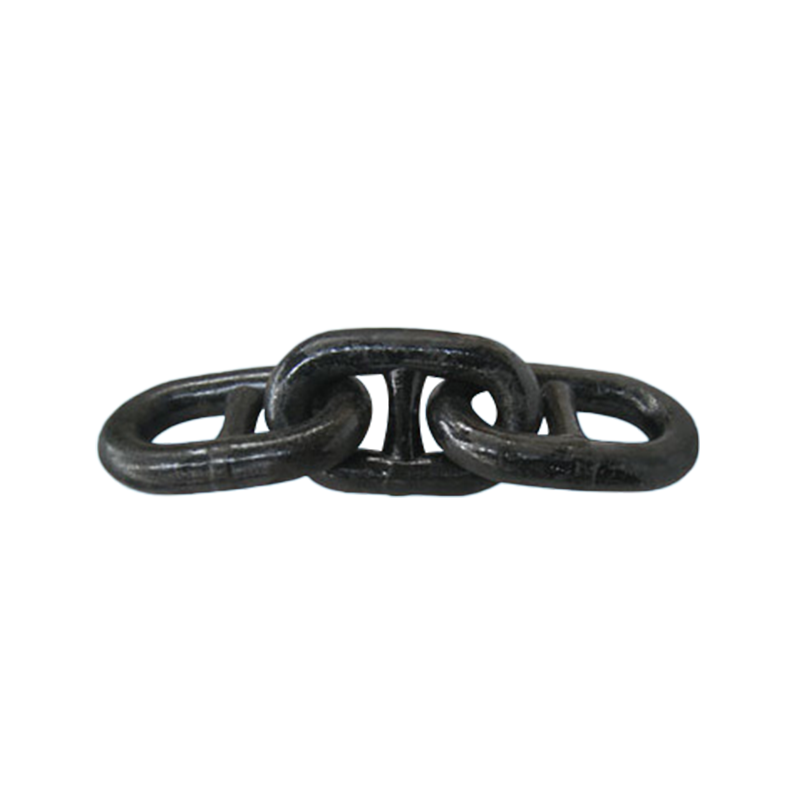 Studded Anchor Chains with High Tensile StrengthAvailable in a wide range of sizes and grades, this chain delivers the catenary weight and chafe protection needed to keep buoy moorings stable in harbors and coastal areas.View Product →
Most buoy moorings in harbors and coastal areas use an all-chain system or a chain-and-rope combination. The chain section near the bottom protects the rope from chafing and provides the catenary weight that keeps the entire mooring stable.
The way a buoy is held in place changes dramatically with water depth. In a lake, harbor or river, a shorter and heavier mooring works well. The buoy may sit in only a few meters of water, with chain running straight down to a concrete or cast iron sinker, and the whole assembly is simple to inspect and service.
Deep-ocean buoys, by contrast, may be moored in thousands of meters of water. Long synthetic ropes provide the elasticity needed to absorb wave energy, and intermediate flotation is added at mid-depth to keep the line from sagging onto the seafloor. Chain is still used near the bottom, and sometimes near the surface, to handle the heaviest loads and prevent abrasion. At every scale the same principle applies: heavy components fix the system to the bottom, elastic components damp the forces, and the buoy rides on top.
Storms are the true test of any buoy mooring. Wind pushes forcefully on the exposed buoy body, waves lift and slam it, and current drags at the whole underwater assembly. If the system were perfectly rigid, these forces would tear the anchor out or snap the line. Instead, the mooring is designed to give a little.
As the buoy is pushed by the storm, the catenary curve steepens, more chain lifts from the seabed, and the elastic rope stretches. This movement absorbs the energy of each wave and prevents sudden shock loading. A well-designed mooring also uses sufficient scope, meaning the line is longer than the water depth, so the buoy never pulls vertically on its anchor.
When we supply buoys to shipyards, port operators, aquaculture farms and marina developers, we recommend thinking about the whole system rather than the buoy alone. A steel spherical or cylindrical buoy is built for heavy-duty use, and it should be matched with the correct chain, shackles and sinker to perform reliably for years.
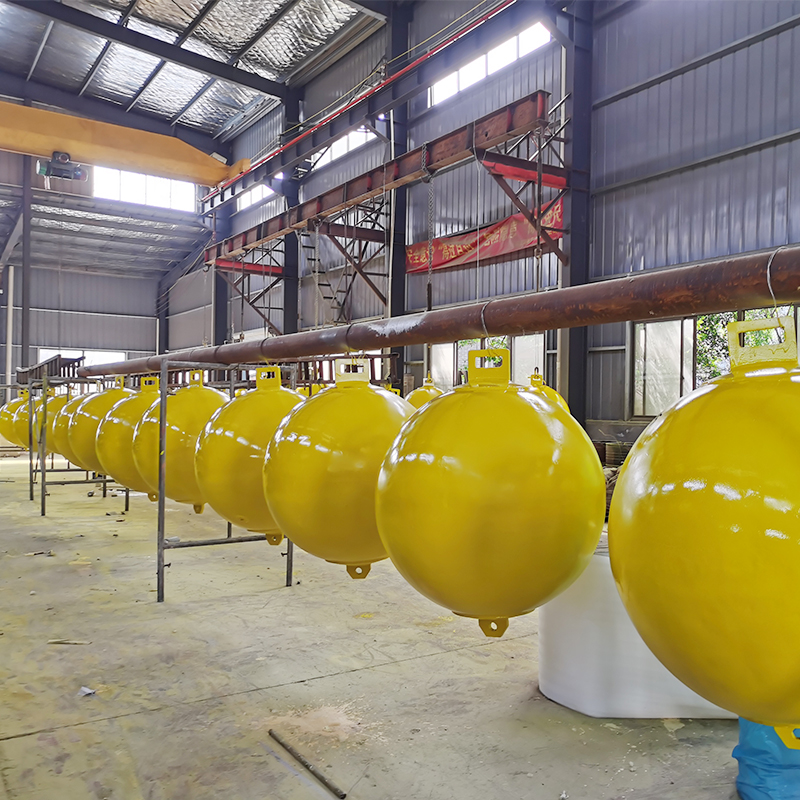 Marine Steel Spherical Buoy for Heavy-Duty UseIts spherical design distributes forces evenly for high stability, and it pairs well with the correct chain, shackles, and sinker to form a dependable permanent mooring system.View Product →
Steel buoys are popular for permanent moorings because they are strong, stable and resistant to impact. For a broader look at the different types of buoys and their uses, our related article on mooring buoy types and applications covers the topic in more depth.
Buoys stay in place because of the careful balance between visible flotation and invisible holding power. The buoy body cannot do it alone; the anchor or sinker fixes the system to the seabed, the chain and rope absorb and transfer the loads, and the connectors keep every part working together.
If you are planning a new mooring or replacing an existing one, the most important decision is usually below the waterline. Choosing the right sinker weight and material is especially critical, and our detailed guide to mooring sinkers and their selection explains how to approach the calculation. With the right components, a buoy can hold its position through calm summers and severe storms alike.
The Importance and Challenges of Marine Anchors Marine anchors are essential components in the operation of vessels, playing a critical role in ensuring the stability and safety of ships while they ar...
READ MOREStability Challenges of Aquaculture Equipment: Why Are Aquaculture Mooring Anchors So Important? In modern aquaculture, especially offshore or offshore aquaculture, equipment stability is the cornerst...
READ MOREThe Role of a PE Yacht Anchor in Enhancing Mooring Stability The stability of a yacht in rough waters is influenced by various factors such as wind, waves, and currents. One of the most critical eleme...
READ MOREWhat materials are used for steel spherical buoys, and what are their structural advantages? As a key component of marine and inland navigation systems, the structural design and material selection of...
READ MORE
Copyright © Nantong Yangfan Marine Equipment Co., Ltd. All Rights Reserved.
